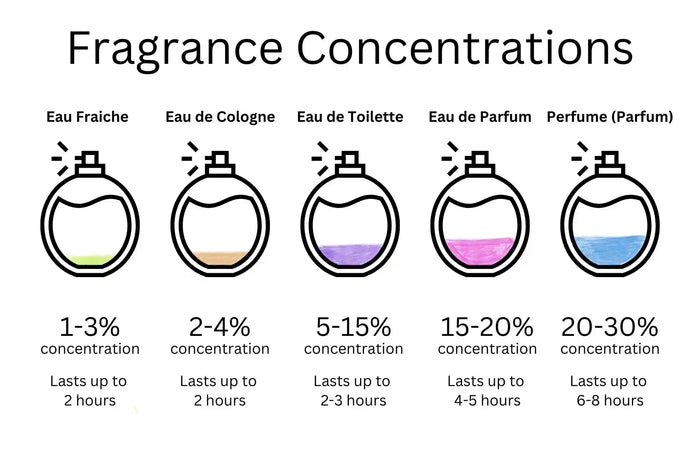
What Is Fragrance Concentration?
When you buy a perfume, you're not buying pure fragrance oil. You're buying a carefully balanced blend of fragrance compounds diluted in alcohol and water. The concentration refers to the percentage of pure fragrance oil in that blend — and it changes everything: how strong it smells, how long it lasts, how it projects, and how much it costs.
Understanding concentration is one of the most important things you can learn as a fragrance enthusiast — and it can save you a lot of money.
The Concentration Spectrum
Eau de Toilette (EDT) — 5–15% Concentration
The most widely purchased fragrance type in the world. EDT tends to be lighter, fresher, and more approachable — often putting the top and heart notes front and centre before the base settles in.
Best for: Everyday wear, office environments, warmer weather, casual outings.
Longevity: 3–5 hours
Projection: Moderate — noticeable up close, not overpowering.
From our collection:
- YSL L'Homme EDT — clean, woody, and effortlessly versatile for daily wear
- YSL La Nuit De L'Homme EDT — the lighter, spicier side of the iconic La Nuit line
- Cartier L'Envol EDT — an airy, honeyed lavender that's polished and understated
- Polo Ralph Lauren 67 EDT — a classic, fresh signature with timeless elegance
Eau de Parfum (EDP) — 15–20% Concentration
Richer, deeper, and longer-lasting. The EDP version of a fragrance shifts the character toward the base — warmer, creamier, and more intense. It's the same DNA but with a noticeably different personality.
Best for: Evening wear, cooler seasons, date nights, or anyone who prefers a fragrance that lasts all day.
Longevity: 5–8 hours
Projection: Strong — will be noticed in a room.
From our collection:
- YSL La Nuit De L'Homme EDP — deeper and more seductive than the EDT, the spices really come alive
- Jean Paul Gaultier Le Male Essence de Parfum — the iconic Le Male DNA pushed darker and smokier
- Cartier L'Envol EDP — the honey and woods intensify beautifully over the EDT version
- Burberry Hero EDP — a bold, earthy juniper and cedarwood that commands attention
- Azzaro The Most Wanted EDP Intense — spiced, caramelised, and dangerously addictive
A common question: "Is EDP always better than EDT?" Not necessarily. Some fragrances are genuinely better in EDT form — the freshness suits them. Others truly shine as EDPs. That's exactly why sampling both first matters.
Parfum / Extrait de Parfum — 20–40% Concentration
The purest form. Parfum is applied sparingly, lasts all day, and sits closer to the skin — less projection outward, more of a personal aura. The character often becomes smoother, richer, and more luxurious.
Best for: Special occasions, intimate settings, cold weather, and fragrance connoisseurs.
Longevity: 8–12+ hours
Projection: Intimate — skin-close rather than room-filling.
From our collection:
- Jean Paul Gaultier Le Male Parfum — the warm, iconic vanilla-lavender in its most concentrated and refined form
- Jean Paul Gaultier Le Male Elixir Absolu — a rich, gourmand powerhouse built for cold nights
- Giorgio Armani Acqua Di Gio Parfum — the classic aquatic freshness evolves into a deep, incense-tinged masterpiece
- Azzaro The Most Wanted Parfum — the spiced warmth reaches full depth here, smooth and long-lasting
- Hermès Voyage d'Hermès Parfum — quietly refined, mineral and woody with exceptional longevity
EDT vs EDP — What Actually Changes?
It's not just about strength — two versions of the same fragrance can smell meaningfully different.
| Factor | EDT | EDP |
|---|---|---|
| Concentration | 5–15% | 15–20% |
| Opening | Brighter, fresher | Richer, deeper |
| Heart notes | More prominent | More blended |
| Base notes | Lighter | Stronger, warmer |
| Longevity | 3–5 hours | 5–8 hours |
| Best season | Spring / Summer | Fall / Winter |
| Price | Lower | Higher |
A perfect real-world example — YSL La Nuit De L'Homme:
- The EDT is spicy and sensual with a lighter, airy quality — cardamom and cedarwood shine
- The EDP is darker and more intense — the base becomes richer and the sillage is noticeably stronger
We carry both. Try them back to back and you'll immediately understand why concentration matters.
Another great comparison — Cartier L'Envol:
- The EDT is delicate and honeyed, with a soft lavender opening
- The EDP takes the same DNA and makes it warmer, woodier, and more assertive
And across the full spectrum — Jean Paul Gaultier Le Male:
- Essence de Parfum (EDP) — smokier and darker than the original
- Le Male Parfum — the full warm vanilla-lavender heart in concentrated form
- Le Male Elixir Absolu — bold, gourmand, and intense from first spray to final drydown
Why This Matters Before You Buy
Most people purchase a full bottle without knowing which version suits them. The result? Expensive disappointment. Knowing concentration helps you:
- Set realistic expectations for how long it will last
- Choose the right version for your lifestyle and the season
- Understand why reviews vary — one reviewer might love the EDT while another finds it weak because they wore the EDP
- Avoid paying full price for the wrong version of an expensive fragrance
The Smartest Way to Navigate Concentrations
Try both versions as decants first.
At SplitzAroma, we carry multiple concentrations of popular fragrances for exactly this reason. Wear the EDT one day and the EDP the next. Notice how the base notes come forward, how the longevity changes, how the projection shifts. Then make an informed decision on the bottle.
It's a fraction of the cost — and it eliminates the guesswork entirely.
Quick Reference Guide
| Type | Concentration | Longevity | Best For |
|---|---|---|---|
| Eau de Toilette | 5–15% | 3–5 hrs | Daily, office, warm weather |
| Eau de Parfum | 15–20% | 5–8 hrs | Evening, cool weather |
| Parfum / Extrait | 20–40% | 8–12+ hrs | Special occasions, intimate |
Browse SplitzAroma's collection — EDT, EDP, and Parfum versions available to sample before you commit.