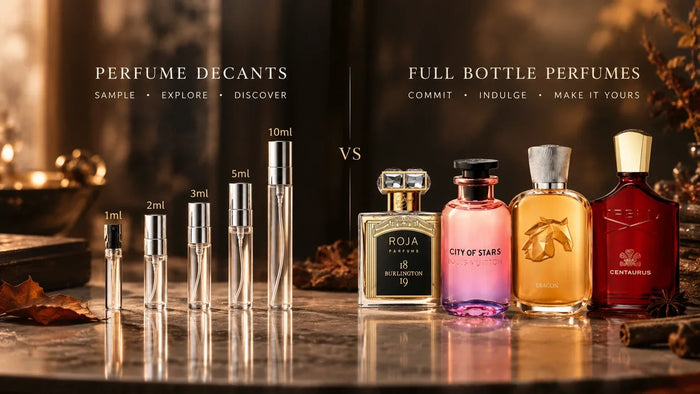
Open your perfume drawer right now. Be honest, how many of those full bottles are still more than half full a year after you bought them? For most people, the answer is almost all of them. That's not really a storage problem. It's a math problem.
The Real Math Nobody Does Before Buying
Here's the part nobody tells you at the counter. A standard spray uses roughly 0.1mL, and most people use about 4 or 5 sprays per wear, so call it 0.5mL a wear. That means a 100mL bottle holds around 200 wears in it.
Now think about how you actually wear fragrance. Even someone who's genuinely into perfume tends to rotate. A scent for a few weeks, then the mood shifts, or the season changes, or a new release catches their eye. Realistically, most people get somewhere between 20 and 40 wears out of a bottle before reaching for something else, not 200. That's only about a tenth to a fifth of the bottle actually used. The rest just sits there, still full, quietly not being worn.
A decant flips that math around. Take something like a 10mL decant. Using that same 0.5mL a wear estimate, that's about 20 wears, which lines up almost exactly with how long most people actually stay interested in one scent. You're not paying for 180 wears you were never going to get to. You're paying for the wears you'll actually use, in a size that costs a fraction of the full bottle instead of a fraction of the value.
This is the entire logic behind buying perfume decants Canada shoppers have been switching to instead of committing to bottle after bottle. The same budget that buys one full bottle can build five or six decants covering completely different moods, occasions, and seasons.
When a Full Bottle Actually Makes Sense
We're not going to pretend decants are always the answer, because that wouldn't be honest, and honest is the whole point. If you've already worn something through a decant or two, worn it in different weather, worn it to work and out at night, and you're still reaching for it months later, that's exactly when a full bottle earns its price. At that point you're not gambling somewhere between $150 and $250 on a guess. You're buying something you already know performs on your skin. That's the one scenario where the full bottle's better price per mL actually pays off, because you'll genuinely use enough of it to get there.
The Thing Competitors Don't Say Out Loud
One honest counterpoint worth naming: a decant that sits around opened and exposed to air and light will fade faster than the same juice sealed in its original bottle. That's true, and we're not going to pretend otherwise. But it's also a solved problem, not a reason to avoid decants. Keep it capped, out of direct sunlight, away from heat, and a decant holds up fine for the length of time it actually takes you to wear it out. The scenario where this matters is buying way more decants than you'll use in a reasonable window, not decants themselves.
And While We're Being Honest About Full Bottles Too
The other thing worth saying plainly is that an expensive, hyped up bottle doesn't automatically mean it'll blow you away or last all day on your skin. Price and reputation aren't the same thing as performance. That's exactly why testing something as a decant first, before spending real money on a full bottle, protects you from the letdown of a $200 bottle that just didn't live up to the hype.
The Actual Decision
Building a small rotation through decants isn't the "budget version" of owning perfume properly. It's the version that actually matches how fragrance gets worn. Full bottles make sense once you already know, not first while you're still guessing. Once you've actually worn something enough to know it's one you'll reach for for months, that's the moment to commit, not before.
If you're not sure yet which direction is yours, that's exactly the point of starting small.